Most travel blogs won’t tell you this upfront. Southeast Asia is cheaper than your monthly car payment.
We know because we lived it. Seven months across Thailand, Vietnam, Cambodia, Malaysia, Singapore, Indonesia, the Philippines, and Laos, and by the time we did the honest math, the trip cost about the same as our van life. That’s not a sales pitch. It’s just geography, and a willingness to look at the actual numbers before assuming you can’t afford it.
So here they are. Real numbers, the ones we actually paid. A genuine 10-day breakdown for two people traveling Southeast Asia the way we travel. Not luxury, not rock-bottom suffer-mode. Comfortable, immersive, real.
First, the context
We’re not backpackers in the 22-years-old-sleeping-in-dorms sense. We want private rooms. We want to eat well. We want the occasional cold beer without counting every baht. We travel slowly, fewer places and more time, which almost always costs less than rushing between destinations.
This breakdown reflects that style. If you’re happy with dorm beds and street food only, it comes in lower. If you want boutique hotels and nightly restaurant dinners, it comes in higher. The framework stays the same either way.
For this breakdown, we’re anchoring in Thailand and Vietnam, two countries we know well, with some Laos context for comparison. Prices are in USD and are what we paid on the ground during our trip in 2024 and 2025.
The daily breakdown, two people, 10 days
Accommodation: $25 to $45/night total
Private rooms in family-run guesthouses run $15 to $30 a night across most of Thailand and Vietnam. In Laos, you can find clean, comfortable rooms for even less. In Chiang Mai, we regularly stayed in lovely spots for under $20 a night. In Hanoi and Hoi An, $25 to $35 gets you something charming, sometimes with breakfast included.
Vietnam tends to run a little cheaper than Thailand across most categories.
Budget: $30/night average for two → $300 for 10 nights
Food: $25 to $40/day for two
This is where Southeast Asia defies logic if you’re used to Western prices.
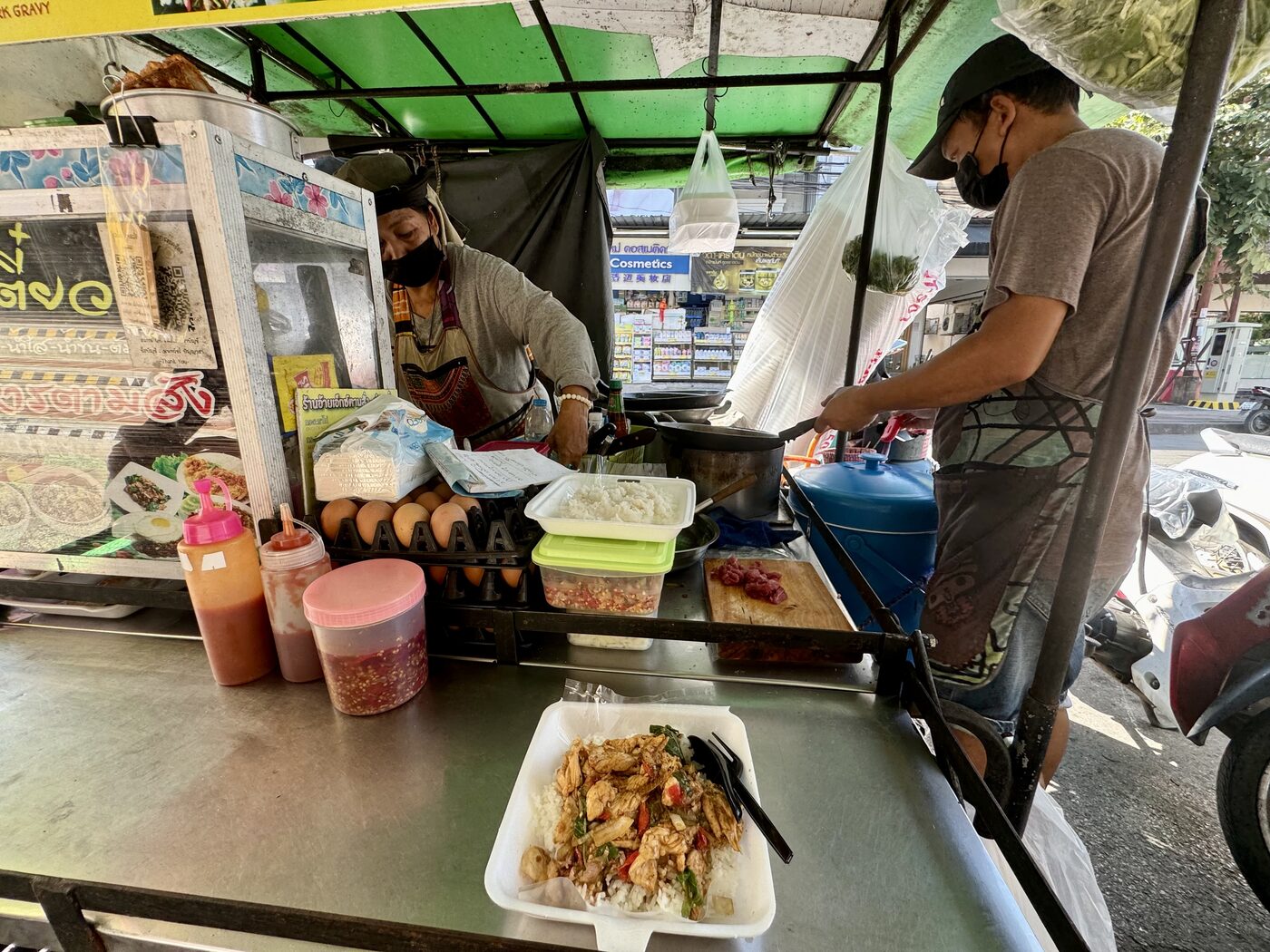
Street meals (pad thai, pho, bánh mì) run $1 to $2 each. Sit-down restaurant mains land at $4 to $8. We eat street food for most breakfasts and lunches, then allow ourselves a proper sit-down dinner most nights. Cold local beers (Singha in Thailand, Bia Hà Nội in Vietnam, BeerLao in Laos) run $1 to $2 a bottle.
A real day of eating for two people (coffee, two street breakfasts, a proper lunch, dinner at a local restaurant, two beers each) comes in around $20 to $30 without trying hard.

Budget: $30/day for two → $300 for 10 days
Local transport: $5 to $15/day for two
Grab makes city transport inexpensive and scam-proof. Scooter rentals run $5 to $8 per day if you’re comfortable riding, and they’re worth it. Between cities, sleeper buses and night trains run $10 to $30 for long hauls, and an overnight bus means you’re saving a night of accommodation at the same time.
Budget: $10/day average for two → $100 for 10 days
Activities: $5 to $20/day for two
Many of the best experiences in Southeast Asia are free or nearly free. Temples. Markets. Wandering. The things that stick with you rarely cost much. We budget deliberately for a few paid experiences (a cooking class, a boat tour, a guided trek) and spread them across the trip. Jungle trekking with a guide generally runs $30 to $50 per day total. Temple entry, where it’s not free, is typically $1 to $5.
Budget: $10/day average for two → $100 for 10 days
Buffer: visas, SIM cards, the unexpected
Visa fees, entrance fees, SIM cards, and small surprises add roughly $3 to $6 per person per day when averaged across a trip. Vietnam’s e-visa runs around $25 per person. A local SIM costs $5 to $10 for the trip. Factor in a small emergency cushion and you’re covered.
Budget: $100 flat for the trip for two
The 10 day total
| Category | Budget |
|---|---|
| Accommodation | $300 |
| Food & Drink | $300 |
| Local Transport | $100 |
| Activities | $100 |
| Buffer / Visas / SIM | $100 |
| Total on the ground | $900 |
That’s $45 per person per day, all in.
For comparison, across the whole trip we averaged about $1,800 a month for the two of us, closer to $60 a day. A short trip costs more per day: you move more, you book more first nights, and you fit more into less time. Budget for the ten-day number, and enjoy it if you come in under.
Add international flights (budget $700 to $1,100 per person return from the US depending on flexibility and timing) and a 10-day trip for two comes in somewhere between $2,500 and $3,200 total, flights included.
On flights: the difference between the low and high end of that range usually comes down to two things, timing and tools. We book 6 to 8 weeks out for the best combination of availability and price, and we use Skyscanner and Going to track fares and catch deals before they disappear. We put as much as we can on our Capital One Venture X card and earn travel points on it, but many street vendors only take cash, so we always make sure to carry cash as well. Over a trip like this, the points add up to meaningful money toward the next one.
On travel insurance: it’s not in the table above because the cost varies, but don’t skip it. A basic policy for two people covering a 10-day international trip typically runs $50 to $100. Given what a single medical evacuation or canceled flight can cost, it’s the most rational line item in the entire budget.
What moves the number up or down
Slower travel costs less. The biggest budget leak in Southeast Asia isn’t food or accommodation. It’s transportation between places. Every time you move cities, you spend. Stay longer in fewer spots and the daily average drops noticeably. This is the single most effective thing you can do for your budget, and it makes the trip better at the same time.
Islands cost more than the mainland. Popular Thai islands like Phuket, Koh Phi Phi, and Koh Samui cost noticeably more than the mainland. Factor this in if beach time is part of the plan.
Peak season adds cost. Costs run higher during peak season (December through February in Thailand). Shoulder season (March through May, September through October) offers the best combination of lower prices and manageable crowds.
Couples have a structural advantage. A double room usually costs only a little more than a single, so two people sharing pay far less each than one person traveling alone.
The honest comparison
What we kept coming back to during those seven months was how embarrassing the math was.
The cost of two people living and traveling through Southeast Asia for a month was comparable to, and sometimes less than, what two people spend on rent, groceries, and routine expenses in many American cities. It stopped feeling like a vacation splurge and started feeling like a lifestyle that cost less than the one we’d left behind.
It won’t suit everyone. But run the actual numbers before you decide it’s out of reach.
The world is cheaper than most people assume. They just never check.
All prices are what we paid in 2024 and 2025 and will vary based on travel style, season, and destination.